How PPC Advertising Works
You search for something on Google, and before you even get to the real results, you see a handful of ads sitting right at the top. Ever wonder how those businesses got there — and whether it’s worth doing yourself? That’s pay per click advertising in action, and it’s one of the most direct ways to put your business in front of people who are ready to buy.
Unlike organic strategies that take months to build momentum, PPC can put you at the top of the page within hours of hitting launch. For small business owners, startups, and marketers who need results on a deadline, that speed is hard to ignore.
Whether you’re a beginner or a business owner looking to improve your online marketing, this guide will help you understand how PPC advertising works. You’ll learn about ad platforms, keyword bidding, campaign optimization, key performance metrics, and the best practices for getting better results.
What Is PPC Advertising?
So, what is PPC? It stands for Pay Per Click, and at its core, it’s simple: you create an ad, someone clicks it, and you pay a fee for that click. No click, no charge.
That single rule changes everything about how you approach advertising. You’re not paying to be seen—you’re paying for action. This makes pay per click advertising fundamentally performance-based, which is part of why it’s so widely trusted by businesses that need to justify every dollar of ad spend.
A few key concepts sit underneath this model:
- Bids—the amount you’re willing to pay for a click
- Keywords—the search terms that trigger your ad
- Ad Rank—the score that decides where (or if) your ad appears
- Quality Score—Google’s measure of how relevant and useful your ad is
Businesses use PPC because it gives them control that’s hard to get anywhere else. You choose your audience, your budget, your timing, and your messaging—and you can change any of it the moment it stops working. A local gym, for example, might run a pay per click campaign targeting “personal trainer near me” and start getting calls the same afternoon.
How Pay Per Click Advertising Works
It starts with keyword research — figuring out exactly what your potential customers are typing into Google. This isn’t guesswork; tools like Google Keyword Planner show real search volume and competition levels so you’re targeting terms people actually use.
From there, you move into account and campaign setup, where you define your goal (calls, sales, website visits), set a budget, and choose your target locations and audience.
Next comes ad creation — writing headlines and descriptions that speak directly to the searcher’s need, plus adding extensions like phone numbers or site links that make your ad more useful.
Once your ads are live, every relevant search triggers an ad auction. Google evaluates every eligible advertiser’s bid and Quality Score in real time to decide the order ads appear in — a process that takes a fraction of a second.
When someone clicks, they land on your landing page, which should match exactly what the ad promised. A mismatched landing page is one of the fastest ways to waste ad spend.
From there, conversion tracking tells you what happened next — did they buy, call, or sign up? Without this step, you have no real way to know if your campaign is actually working.
Finally, ongoing optimization — reviewing performance, cutting weak keywords, testing new ad copy — is what turns an average pay per click campaign into a consistently profitable one.
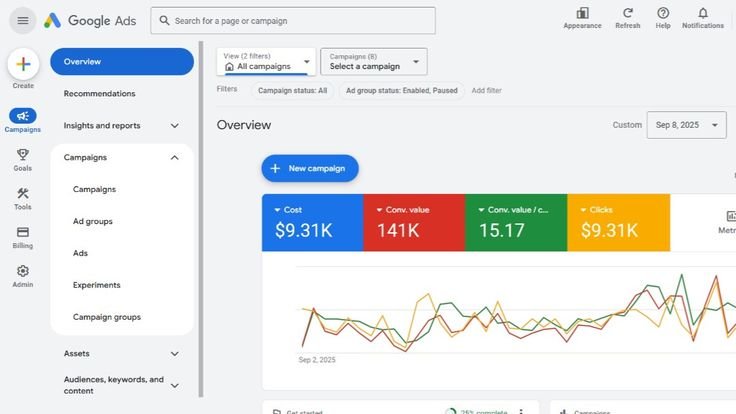
What Is Google Ads?
When people ask what is Google Ads, they’re referring to the platform most PPC advertising runs through. Understanding its structure makes everything else about PPC click into place.
Account Structure
A Google Ads account sits at the top level, holding your billing information and overall settings.
Campaigns
Inside your account, campaigns represent your broader goals — say, one campaign for brand awareness and another for direct sales.
Ad Groups
Each campaign is broken into ad groups, which organize closely related keywords and the ads that target them.
Keywords
These are the search terms you’re bidding on, ranging from broad phrases to highly specific, long-tail searches.
Bidding
You set how much you’re willing to pay, either manually or through Google’s automated bidding strategies, which use machine learning to adjust bids toward your goals.
Quality Score
This 1–10 rating reflects your ad’s relevance, expected click-through rate, and landing page experience — and directly affects how much you pay.
Ad Rank
Ad Rank combines your bid with Quality Score and other signals to determine your ad’s position. A well-optimized, relevant ad can beat a bigger budget with a weaker setup.
Types of PPC Campaigns
Different goals call for different ad formats. Here’s a quick rundown of the main types you’ll come across.
Search ads are text-based and appear directly in Google’s search results, ideal for capturing people actively looking to take action.
Display ads are visual banners shown across millions of partner websites, better suited for building awareness than driving instant sales.
Shopping ads show a product photo, price, and store name right in search results, making them a strong fit for ecommerce.
Video ads run on YouTube, useful for storytelling and reaching people earlier in their buying journey.
App ads are built specifically to drive installs and in-app actions across Search, Play Store, and YouTube.
Local campaigns are designed to drive foot traffic to physical store locations, appearing across Search, Maps, Display, and YouTube.
Performance Max campaigns run across all of Google’s channels from a single setup, using automation to find the best-performing combinations without manual channel-by-channel management.
Benefits of PPC Advertising
The appeal of pay per click advertising comes down to a handful of real, practical advantages.
You get speed — a campaign can start generating traffic the same day it launches, unlike SEO, which often takes months. You get precise targeting, reaching people by keyword, location, device, and even time of day. You get measurable results, since every click, cost, and conversion is tracked in detail. And you get flexibility, since budgets and targeting can be adjusted instantly if something isn’t performing.
Here’s how those benefits play out in practice:
| Benefit | What It Looks Like in Practice |
| Speed | Ads go live and start receiving clicks within hours |
| Targeting | Reach people searching a specific term in a specific city |
| Measurability | Track exact cost per lead or sale, down to the keyword |
| Flexibility | Pause, adjust, or scale budget instantly based on results |
| Control | Set a hard daily spending limit that’s never exceeded |
PPC vs SEO
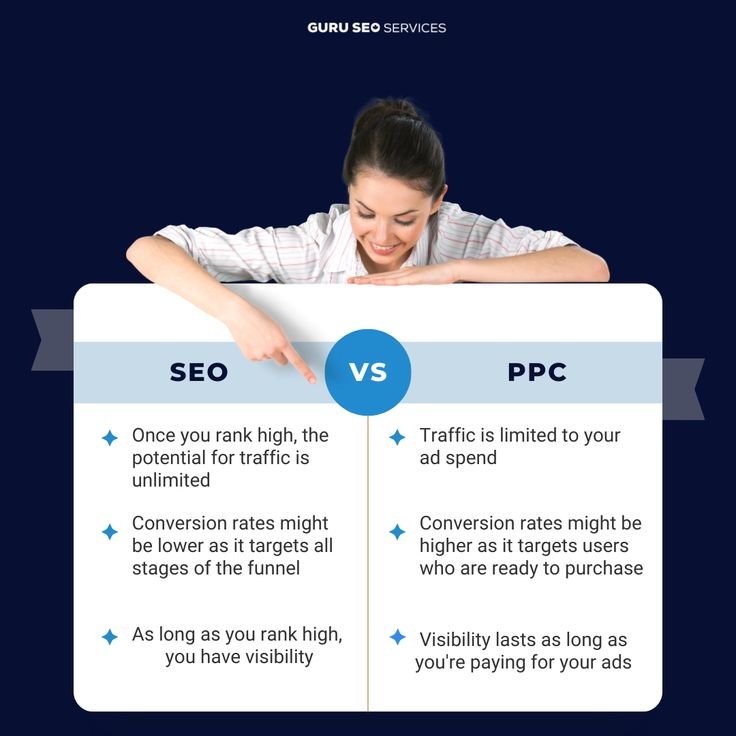
One of the most common questions beginners ask is whether PPC or SEO is the better investment. The honest answer is that they solve different problems, and most businesses eventually use both.
| Factor | PPC | SEO |
| Cost | Ongoing cost per click | Free clicks, but requires time/content investment |
| Speed | Results within hours | Results over weeks to months |
| Sustainability | Traffic stops when budget stops | Traffic continues after ranking is achieved |
| ROI | Immediate and precisely trackable | Compounds over time |
| Traffic | Paid placement, auction-based | Organic, earned placement |
| Best Use Case | Fast launches, promotions, testing offers | Long-term brand authority and content growth |
If you need customers this week, pay per click advertising is the faster route. If you’re building for the next three years, SEO usually pays off better in the long run.
Common PPC Mistakes
Even seasoned advertisers slip up here. Watch for these:
- Bidding on overly broad keywords that bring in irrelevant clicks
- Skipping negative keywords, which lets your budget leak to unrelated searches
- Sending every click to a generic homepage instead of a dedicated landing page
- Never reviewing search term reports to see what people actually typed
- Writing ad copy that doesn’t match what the landing page delivers
- Ignoring mobile page speed, where most searches now happen
- Chasing clicks instead of tracking actual conversions
- Cramming too many unrelated keywords into a single ad group
Best Practices for Running Successful PPC Campaigns
- Group keywords tightly. Closely themed ad groups keep your ads and landing pages relevant to the exact search.
- Build your negative keyword list early. Cut wasted spend before it happens, not after.
- Write ads around intent. Speak to the problem the searcher is trying to solve, not just your product features.
- Match landing pages to ad promises. Consistency builds trust and lifts conversion rates.
- Set up conversion tracking before you launch. You can’t fix what you can’t measure.
- Test more than one ad per group. Let real performance data decide the winner, not your personal preference.
- Check performance weekly, not monthly. Small, frequent adjustments beat rare, big overhauls.
- Layer in automated bidding once you have data. Machine learning can react to signals faster than manual adjustments.
Key PPC Metrics to Track
Running a pay per click campaign without watching the right numbers is like driving with your eyes closed. Here’s what actually matters.
| Metric | What It Measures |
| CPC (Cost Per Click) | The average amount you pay each time someone clicks your ad |
| CTR (Click-Through Rate) | The percentage of people who see your ad and click it |
| CPA (Cost Per Acquisition) | How much you spend, on average, to get one conversion |
| Conversion Rate | The percentage of clicks that result in a desired action |
| ROAS (Return on Ad Spend) | Revenue generated for every dollar spent on ads |
| Quality Score | Google’s 1–10 rating of your ad’s relevance and experience |
| Impression Share | The percentage of available impressions your ad actually received |
Tracking these together, rather than any single metric alone, gives you the full picture of whether a campaign is actually profitable.
Future of PPC Advertising
PPC is moving fast toward automation, and the businesses that adapt early tend to win the most.
AI is now embedded throughout the ad platforms themselves, analyzing signals far beyond what a human could process manually. Smart Bidding uses this AI to adjust bids in real time based on the likelihood of conversion for each individual auction. Automation now touches everything from ad copy suggestions to budget pacing across campaigns.
Audience Signals are becoming just as important as keywords, letting advertisers define who they want to reach based on behavior and interests rather than search terms alone. And Predictive Analytics is starting to forecast performance before a campaign even launches, helping advertisers set smarter budgets and expectations from day one.
The direction is clear: the platforms are handling more of the manual work, which means strategy, messaging, and understanding your customer will matter more than ever.
Conclusion
Pay per click advertising gives businesses something few other marketing channels can: speed, control, and measurable results from day one. From understanding the auction system to tracking the right metrics, everything about pay per click advertising comes down to relevance and consistent optimization. Whether you’re launching your first pay per click campaign or refining a strategy you’ve run for years, the fundamentals stay the same — target the right people, say the right thing, and keep testing. Pay per click advertising rewards businesses that treat it as an ongoing process rather than a one-time setup. If you’ve been sitting on the sidelines, there’s no better time to launch your first pay per click advertising campaign and start turning searches into customers.
FAQs
1. What is PPC advertising in simple words? PPC, or pay per click advertising, is a model where you pay a fee only when someone clicks your ad, rather than paying a flat rate to have it displayed.
2. What is Google Ads and how is it related to PPC? Google Ads is the platform most businesses use to run pay per click campaigns across Google Search, Display, YouTube, and Shopping.
3. How does the PPC auction decide ad position? It combines your bid amount with your Quality Score and expected ad impact to calculate Ad Rank, which determines where your ad appears.
4. What’s the difference between PPC and SEO? PPC delivers paid, immediate traffic through an auction system, while SEO builds free, organic traffic over a longer period of time.
5. How much should a beginner budget for a pay per click campaign? Many beginners start with a modest daily budget, often between $5 and $20, and scale up once they see which keywords convert.
6. What is Quality Score and why does it matter? Quality Score is a 1–10 rating of how relevant your ad, keywords, and landing page are, and it directly affects your cost per click.
7. Which PPC metrics matter most for a small business? CPA and conversion rate typically matter most, since they show whether a campaign is actually generating profitable results, not just clicks.
8. Can PPC and SEO work together? Yes, many businesses run both simultaneously, using PPC for immediate visibility while SEO builds long-term, sustainable organic traffic.