If you’ve ever wondered what is digital marketing and why every business seems obsessed with it, you’re in the right place. Whether you’re a student exploring career options, a business owner trying to grow online, or simply someone curious about how brands reach people on the internet — this guide will break it all down for you in plain, simple language.
Digital marketing is a need now. It’s how companies grow and endure in the hyperconnected world of today. There are more than 5 billion internet users worldwide, making it easier than ever to connect with your potential client online. Furthermore, neither a large budget nor a degree in marketing are necessary to get started.
Even if you are a total novice, you will have a thorough understanding of what digital marketing is, its various forms, its main advantages, and how to use it to expand your company by the end of this guide.
What Is Digital Marketing?
Digital marketing is a modern way of promoting businesses using the internet. Instead of relying only on newspapers, TV, or billboards, companies connect with their audience through search engines, social media platforms, email campaigns, websites, and online advertisements. It helps businesses reach the right people at the right time while delivering measurable results.
The biggest difference between traditional marketing and digital marketing is where it happens. Traditional marketing relies on offline methods like TV commercials, billboards, newspapers, and magazines, while digital marketing reaches customers online. Because everything is digital, businesses can target specific audiences, track campaign performance instantly, and make quick adjustments to improve results.
Think about it this way: when you search “best running shoes” on Google and see ads at the top, when you scroll Instagram and notice a sponsored post, or when you get an email from a brand you love — that’s all digital marketing in action.
Businesses of every size, from solo freelancers to Fortune 500 companies, use digital marketing to:
- Build brand awareness
- Generate leads and sales
- Retain existing customers
- Compete with larger rivals on a level playing field
Digital marketing is fundamentally about using the internet as a medium to deliver the right message to the right person at the right time.
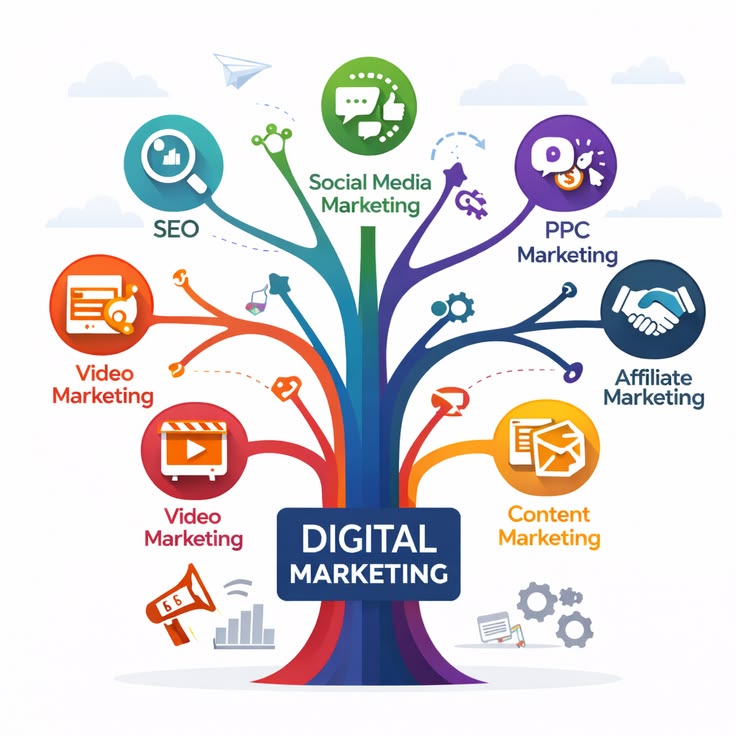
Digital Marketing Explanation
Let’s break this down even further with a clear, beginner-friendly digital marketing explanation.
Online vs Traditional Marketing
| Traditional Marketing | Digital Marketing |
| TV, radio, print ads | Social media, email, SEO |
| One-way communication | Two-way engagement |
| Difficult to track ROI | Real-time analytics |
| High cost, slow to adjust | Cost-effective, flexible |
| Broad, untargeted reach | Precise audience targeting |
| Local or regional scale | Global reach |
In traditional marketing, businesses advertise to everyone and hope the right people notice. With digital marketing, you can target specific audiences based on their interests, location, demographics, and online behavior.
The Customer Journey
In digital marketing, the customer journey typically moves through these stages:
- Awareness — The customer discovers your brand (through Google, social media, or a blog post)
- Interest — They explore your content and start learning more
- Consideration — They compare options and evaluate your offer
- Decision — They make a purchase or take action
- Retention — You nurture the relationship for repeat business
Digital marketing covers every one of these stages. SEO helps with discovery; email marketing helps with retention; paid ads can accelerate decisions.
The Digital Marketing Ecosystem
The digital marketing ecosystem is a web of interconnected channels: search engines, social media platforms, email, websites, mobile apps, and more. Each channel plays a role, and the most effective strategies use multiple channels together, creating what marketers call an omnichannel experience.
Why Digital Marketing Matters Today
We live in a world where people reach for their phones before they reach for the TV remote. Here’s why digital marketing matters more than ever:
Online Visibility: If your business isn’t online, you effectively don’t exist for a growing percentage of consumers. Over 90% of purchasing decisions now begin with an online search.
Brand Awareness: Digital channels allow businesses to build brand recognition at scale — consistently showing up in someone’s feed, inbox, or search results builds familiarity and trust.
Customer Engagement: Social media and email make it possible to have real conversations with your audience. You’re not broadcasting — you’re connecting.
Measurable ROI: One of the biggest advantages of digital marketing is that you can measure everything. Click-through rates, conversion rates, cost per lead — the data tells you exactly what’s working.
Business Growth: From a local bakery to an e-commerce store, businesses that invest in digital marketing consistently outgrow those that don’t. It levels the playing field and gives small businesses access to audiences that were once only reachable by big brands.
Types of Digital Marketing
There are many types of digital marketing, each serving a different purpose. Here’s a breakdown of the most important ones.
SEO (Search Engine Optimization)
SEO is the process of optimizing your website so it appears higher in search engine results pages (SERPs) like Google. When someone searches for a product or service you offer, good SEO ensures they find you — not your competitor.
SEO involves keyword research, on-page optimization (meta titles, headings, content), technical improvements (site speed, mobile-friendliness), and link building.
PPC (Pay-Per-Click Advertising)
PPC is paid advertising where you only pay when someone clicks your ad. Google Ads and Meta (Facebook/Instagram) Ads are the most popular platforms. PPC is ideal for driving fast, targeted traffic — especially for promotions or new product launches.
Social Media Marketing
This involves promoting your brand on platforms like Instagram, Facebook, LinkedIn, TikTok, and X (Twitter). It includes both organic posts and paid social ads. Social media is powerful for building community, increasing brand awareness, and driving engagement.
Content Marketing
Content marketing focuses on creating valuable, relevant content — blog posts, videos, infographics, podcasts — that attracts and educates your target audience. It’s a long-term strategy that builds trust, drives organic traffic, and positions you as an authority in your niche.
Email Marketing
Despite being one of the oldest digital marketing channels, email remains one of the most effective. With an average ROI of $36 for every $1 spent, email marketing is ideal for nurturing leads, promoting offers, and maintaining customer relationships.
Affiliate Marketing
In affiliate marketing, you partner with other people (affiliates) who promote your product in exchange for a commission on each sale. It’s performance-based, which means you only pay for results.
Influencer Marketing
Influencer marketing taps into the audiences of social media creators. Brands collaborate with influencers — from mega-celebrities to micro-influencers with niche followings — to promote their products authentically.
Video Marketing
Video is the most consumed content format online. YouTube, TikTok, Instagram Reels, and LinkedIn video all offer opportunities to engage audiences visually. Explainer videos, product demos, testimonials, and behind-the-scenes content all fall under this category.
Benefits of Digital Marketing
The benefits of digital marketing are wide-ranging and apply to businesses of all sizes. Here’s a closer look:
1. Cost-Effectiveness: Running a Facebook ad campaign for $10/day is infinitely more accessible than booking a TV slot. Small businesses can compete with large corporations without matching their budgets.
2. Global Reach: A well-optimized website can attract customers from across the world, 24/7 — without you being awake or present.
3. Precise Targeting: Digital platforms let you target by age, location, interests, behavior, income level, and more. You’re not shouting into a crowd — you’re speaking to the right person.
4. Real-Time Analytics: Google Analytics, Meta Ads Manager, and email platforms show you performance data as it happens. You can pause a campaign, change a headline, or shift your budget instantly.
5. Better Engagement: Two-way communication through social media and email builds real relationships with customers, increasing loyalty and repeat business.
6. Scalability: Whether you’re spending $100 or $100,000 per month, digital marketing scales with you.
7. Personalization: Digital tools allow you to show different messages to different audiences based on their behavior — dramatically improving conversion rates.
How Digital Marketing Works
Understanding how digital marketing works helps you build a strategy rather than just trying random tactics.
Step 1 — Audience Research: Define who your ideal customer is. What are their problems? Where do they spend time online? What keywords do they search for?
Step 2 — Content Creation: Build content that speaks directly to your audience’s needs — blog posts, social media content, videos, landing pages.
Step 3 — SEO: Optimize your content so it ranks in search engines and attracts organic (free) traffic over time.
Step 4 — Social Media: Share your content across relevant platforms and engage with your followers consistently.
Step 5 — Paid Ads: Use PPC and social media ads to amplify your reach and drive targeted traffic faster than organic methods allow.
Step 6 — Analytics: Track what’s working using tools like Google Analytics, Search Console, and your ad platform dashboards.
Step 7 — Optimization: Use data to continuously improve your campaigns. Double down on what works; cut what doesn’t.
Digital Marketing Services
Businesses often hire agencies or freelancers to manage their online presence. The most popular digital marketing services include:
SEO Services: Keyword research, on-page optimization, link building, technical SEO audits.
PPC Management: Google Ads setup, A/B testing, bid strategy, conversion tracking.
Social Media Marketing: Profile management, content creation, community engagement, paid social campaigns.
Content Marketing: Blog writing, video production, infographic design, content strategy.
Email Marketing: List building, campaign creation, automation flows, A/B testing.
Web Design & Development: Building fast, mobile-friendly, conversion-optimized websites.
Conversion Rate Optimization (CRO): Analyzing user behavior and improving landing pages to turn more visitors into customers.
When choosing digital marketing services, look for providers who are transparent about their process, report on results, and align with your business goals.
How to Build a Successful Digital Marketing Strategy
Ready to get started? Follow these steps to build a winning strategy:
Set clear goals — Do you want more website traffic, leads, sales, or brand awareness? Define specific, measurable targets.
Know your audience — Create a detailed customer persona including demographics, interests, pain points, and online behavior.
Choose your channels — Don’t try everything at once. Pick 2–3 channels where your audience is most active.
Create a content plan — Map out what you’ll publish, when, and on which platforms. Consistency is key.
Set a budget — Allocate funds across organic and paid efforts based on your goals and timeline.
Launch and track — Start executing and monitor performance using analytics tools from day one.
Review and optimize — Analyze results monthly, identify what’s underperforming, and continuously improve.
Common Mistakes Beginners Should Avoid
- Skipping audience research — Marketing without knowing your customer is like driving with no destination in mind.
- Trying to be everywhere at once — Focus your energy on a few channels rather than spreading yourself thin.
- Ignoring SEO — Many beginners focus only on paid ads and miss the long-term value of organic search traffic.
- Not tracking results — If you’re not measuring, you’re guessing. Set up Google Analytics and conversion tracking from day one.
- Inconsistent content publishing — Sporadic posting kills audience growth. Create a content calendar and stick to it.
- Expecting overnight results — SEO and content marketing take time. Give strategies at least 3–6 months before judging them.
- Neglecting mobile users — More than half of all web traffic comes from mobile devices. Always optimize for mobile.
- Copying competitors blindly — What works for another brand may not work for yours. Test, learn, and find your own voice.
Future of Digital Marketing
The world of digital marketing is evolving rapidly. Here’s what’s shaping its future:
AI and Machine Learning: AI tools are automating everything from ad bidding to content creation to customer service. Marketers who embrace AI will work faster and smarter.
Marketing Automation: Platforms like HubSpot and ActiveCampaign allow businesses to set up complex, personalized customer journeys that run on autopilot.
Voice Search: With the rise of smart speakers and voice assistants, optimizing for conversational, long-tail keywords is becoming increasingly important.
Personalization at Scale: Consumers expect personalized experiences. Data-driven personalization will become a standard — not a differentiator.
Short-Form Video: TikTok, Instagram Reels, and YouTube Shorts are dominating attention. Video marketing will only grow in importance.
Data-Driven Marketing: Privacy changes (like the decline of third-party cookies) are pushing marketers toward first-party data collection and smarter analytics.
The brands that stay ahead will be those that embrace these shifts early, keep learning, and remain focused on delivering genuine value to their audiences.
What is Search Engine Optimization? Powerful Benefits and Common Mistakes Every Business Should Know
Every business wants to attract more customers online, but not every website gets noticed. If you’ve been wondering What is Search Engine Optimization, you’re asking one of the most important questions in digital marketing. Search engines like Google are often the first place people look when they need a product, service, or solution. If your website isn’t visible in those search results, you’re likely losing valuable opportunities to competitors who have invested in SEO.
Search Engine Optimization (SEO) is one of the most effective digital marketing strategies for improving your website’s visibility in search engines. It helps your business reach the right audience at the right time without depending entirely on paid advertising. From increasing organic traffic and building customer trust to improving brand awareness, SEO plays a vital role in long-term business success.
SEO is a powerful marketing strategy, but its success depends on how effectively it’s implemented. Many businesses focus only on reaching the top of search results without paying attention to the factors that influence long-term performance. By learning the benefits of SEO and avoiding common mistakes, you can improve your website’s visibility, build trust, and achieve consistent growth.
Conclusion
Understanding what is digital marketing is the first step toward unlocking massive growth opportunities for any business in today’s online world. From SEO and social media to email campaigns and paid ads, digital marketing gives you the tools to reach the right audience, build meaningful relationships, and grow your business — regardless of your budget or starting point.
The key is to start with a clear strategy, stay consistent, measure your results, and keep learning as the landscape evolves.
Whether you’re just getting started or looking to sharpen your skills, the best time to invest in digital marketing is right now. The businesses thriving online today aren’t necessarily the biggest — they’re the ones that showed up consistently and adapted quickly.
Ready to start your digital marketing journey? Pick one channel, commit to it for 90 days, and watch what happens.
FAQ
What is digital marketing in simple terms? Digital marketing is the promotion of products or services using the internet and digital channels like social media, email, search engines, and websites to reach and engage a target audience.
2. What are the main types of digital marketing? The main types include SEO, PPC (paid ads), social media marketing, content marketing, email marketing, affiliate marketing, influencer marketing, and video marketing.
3. Is digital marketing a good career in 2025? Absolutely. Digital marketing is one of the fastest-growing career fields globally, with strong demand for SEO specialists, content marketers, PPC managers, and social media strategists across all industries.
4. How much does digital marketing cost? Costs vary widely. A small business might spend $500–$2,000/month on a basic strategy, while larger companies spend tens of thousands. Many organic strategies like SEO and content marketing require time more than money.
5. Can I learn digital marketing for free? Yes. Google Digital Garage, HubSpot Academy, Moz Blog, and Coursera all offer free or affordable learning resources to help beginners get started.
6. What is the most effective type of digital marketing? It depends on your goals and audience. For long-term growth, SEO and content marketing are highly effective. For quick results, PPC delivers fast, targeted traffic. Most successful businesses use a combination.
7. How long does digital marketing take to show results? Paid ads can generate results within days. SEO and content marketing typically take 3–6 months to show significant organic growth. Consistency over time is what produces the best long-term outcomes.
8. What skills do I need for digital marketing? Core skills include SEO knowledge, content writing, data analysis, social media management, and basic familiarity with ad platforms. Soft skills like creativity, communication, and adaptability are equally important.
What is digital marketing?
Digital marketing is the process of promoting products or services through online channels such as search engines, social media, email, websites, and paid advertising to reach potential customers.
Why is digital marketing important for businesses?
Digital marketing helps businesses increase online visibility, attract targeted customers, generate leads, improve brand awareness, and achieve measurable business growth.
What are the main types of digital marketing?
The major types of digital marketing include SEO, content marketing, social media marketing, email marketing, PPC advertising, affiliate marketing, influencer marketing, and video marketing.
How does digital marketing work?
Digital marketing works by using various online platforms and strategies to attract visitors, engage potential customers, convert them into leads or buyers, and build long-term customer relationships.
Is digital marketing suitable for beginners?
Yes. Anyone can start learning digital marketing with basic concepts, free online resources, and hands-on practice. It is one of the most beginner-friendly career and business skills.
What skills are required to learn digital marketing?
To succeed in digital marketing, you should develop skills in SEO, content writing, social media management, paid advertising, email marketing, analytics, and basic website management.
How long does it take to learn digital marketing?
Most beginners can understand the fundamentals of digital marketing within a few months, while gaining practical expertise typically takes consistent learning and real-world experience.
Can small businesses benefit from digital marketing?
Absolutely. Digital marketing allows small businesses to reach their target audience, compete with larger brands, increase website traffic, and generate more sales on a reasonable budget.
What are the benefits of digital marketing over traditional marketing?
Digital marketing offers better audience targeting, real-time performance tracking, lower marketing costs, higher ROI, and the ability to optimize campaigns based on data.
How can I start learning digital marketing in 2026?
Start by understanding the basics of digital marketing, learning SEO, content marketing, social media marketing, and PPC, then practice by creating your own website or working on real projects to build experience.